Showing posts with label health. Show all posts

Hard to concentrate after strenuous exercise?

Whenever I am doing regular training I noticed that if I do a solid session of exercise, particularly in the morning, that I feel badly spaced-out during the rest of the day. I used to do a bit of climbing, and I used to go in the late afternoon at the Mile End wall, but it basically meant that I would write-off any meaningful work during the rest of the evening.

So post-exercise, I could potter about and procrastinate, but anything requiring concentrated focused effort was almost impossible. I thought it odd that other people, such as those I climbed with, didn't experience similar degradation in concentration.

But since then I've noticed that some other people were reporting similar issues of loss of concentration on a cycling forum, so I googled for the issue, and it seems a common complaint;
"s5fskzfv" on Bike Forums said: "After a long workout I often have trouble concentrating. It's hard to describe exactly what the problem is, it's like if I have something I need to read, or something that takes thinking like balancing a checkbook, I just don't feel like doing it. Trying to concentrate feels uncomfortable to the point that I can't do it. I tend to do a lot of reading, if I didn't, I might not even notice the problem, it's sort of subtle. I'm not sure exactly what it is, maybe not enough sleep or low blood sugar? Usually by the next day I'm back to normal after a couple of meals and some sleep."
NaturalBeasting talking on Testosterone Nation made this post:
"It is extremely difficult for me to do critical thinking after a really ball-busting tough workout. I completely space out and can't focus.

This effect usually lasts for the remainder of that day and sometimes 1-2 days afterwards. (It affects my performance in school/work.)

If I don't workout for a week or so there's a dramatic difference in my mental capabilities.

It's been happening my entire life, despite good sleep, nutrition and overall health.

Anyone else experienced this?

And "strawberry" asked this question on yahoo Answers:

After doing my morning exercise I can't concentrate in lectures..will I just 'outgrow' this?

 I'm 22. I love my exercise. In my summer holidays (I'm at uni), I always start my day with a half-hour workout. But if I'm in the middle of a university term, I find that after doing my morning workout, I find it difficult to concentrate in lectures due to feeling tired from the workout.


So today, I did a short run and some weights, after a bit of a layoff, and right now I am feeling completely unable to work.

I've eaten a good breakfast since, so I don't think that low blood sugar is the issue. Unless its some sort of "hangover" effect. I don't feel tired right now, and I wouldn't be able to doze off, which is unusual for this time of day, whereas normally I could easily have an hours kip.

There are a few theories on the acute changes brought by exercise, both aerobic and muscular;

for example copper and zinc blood levels;
http://www.ncbi.nlm.nih.gov/pubmed/24509996

Elevated brain-derived neurotrophic factor levels;
http://www.ncbi.nlm.nih.gov/pubmed/24495613


This paper seems to suggest, that you benefit from CV fitness, but not from the exercise itself;
These findings suggest that cardiorespiratory fitness, but not acute aerobic exercise, may be beneficial to behavioral and neuroelectric indices of action monitoring following errors of commission by increasing top-down attentional control.

If anyone has got any suggestions on how to alleviate this problem, I am perfectly happy to try them out! (In the name of science)

References

http://www.bikeforums.net/archive/index.php/t-791130.html

http://tnation.t-nation.com/free_online_forum/sports_body_training_performance_bodybuilding/reduced_mental_capacity_after_a_tough_workout

http://uk.answers.yahoo.com/question/index?qid=20111023102110AAZx0Kw


http://www.ncbi.nlm.nih.gov/pubmed/16713115


So here is an example of someone increasing the total sum of cobblers talked about alzheimers in the guardian


(ok, I changed the title, but I was very very angry about what someone wrote on the internet. ;-)

So this guy, (MA in zoology, career as a political journalist, http://en.wikipedia.org/wiki/George_Monbiot) read an article in the new scientist reviewing a paper indicating a metabolic connection between AD, and he comes to this conclusion...

"Alzheimer's disease could be another catastrophic impact of the junk food industry" *

"We cannot yet state unequivocally that poor diet is a leading cause of Alzheimer's disease, though we can say that the evidence is strong and growing. But if ever there was a case for the precautionary principle, here it is." *

* (quotes taken out of context, in order to make it looks as damning as possible)


What next for the HIV derived cure for cancer?

In August of 2011, the New England Journal of Medicine published an editorial article "Redirecting T Cells", which introduced an interim report from a Phase 1 clinical trial of an Anti-Cancer treatment derived from the HIV virus on 3 patients with refractory chronic lymphocytic leukemia (CLL).

The results were extremely positive, with 2 of the 3 patients having undetectable levels of cancer after a follow up at 6 months. That is, in a very limited sense, they had been cured of Cancer.

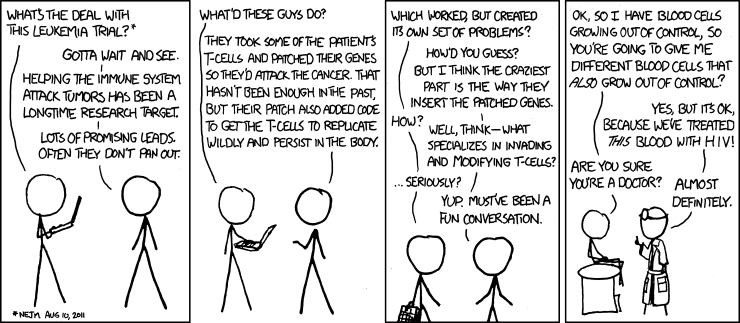
As usual with important scientific matters the best place to go for an informed view on the subject is comedy, and xkcd hit the nail on the head with a perfect mixture of optimism and scepticism in this comic.

http://xkcd.com/938/


From a medical genetics point of view, retroviruses like HIV include a viral enzyme called reverse-transcriptase (RT) of which the function is to incorporate the viral nucleic acid into the genome of the host cell, hence not only does the virus make copies of itself using your own cells, any daughter cells of the original also have copies of the viral genome installed and running.
Very cheeky indeed!

The treatment (nice video from UPenn team here) involves infusing back into patients modified versions of their own T-cells, that have been tinkered with by using the HIV RT enzyme to make the T-cells recognise and attack cancerous cells. However crucially, the modified T-cell genome remains persistent in the host and goes on killing cancer cells beyond the death of original infusion. (see xkcd for a succinct review of the risks and side-effects).


Given the theoretical importance of this type of treatment, I think its worth mentioning how the 3 patient trial was funded:
"The researchers did manage to get a grant from the Alliance for Cancer Gene Therapy, a charity founded by Barbara and Edward Netter after their daughter-in-law died of cancer. The money was enough to finance the trials on the first three patients."

Anyway... so during a conversation about cancer and clinical trials a few days ago I was trying to make the case that despite the cost of phase IV trials being bonkers money, and getting more expensive each year, that there is a productive area for relatively small scale charitable funding which if successful can leverage up to big-pharma funding.

However when I tried to reference a couple of the "facts" that I had used in my claim, it turns out that my memory had served me poorly and I needed to revisit my sources.  It becomes clear why my poor memory is an asset if you read on...

(These mis-remembering fuckups suggest I might do well to enlist on some early stage treatment for memory loss ASAP, or pay more attention the first time... whatever ;-)


R dot plots for Maternal mortality for WHO nation data 2008

Queens hospital in Romford and King Georges in Goodmayes were recently criticised by the health watchdog for extremely poor standards of care, and this quote from the guardian article suggests a level of nasty, that is beyond simple incompetence:

"The CQC report highlighted verbally abusive staff in the maternity unit. One of the midwives was heard to say to a woman in labour: "Hurry up, or I'll cut you." - http://is.gd/dxVosz
 
Surely this person should be arrested, or did i miss something?

The BBC and Guardian both covered the report from the care commission, and its makes for pretty grim reading given that they are my 2 nearest general hospitals.

The article in the Daily-Mail mentions a statistic that they may well have pulled out of their collective arse (who knows they seem to just lie about everything), that the maternal death rate at Queens hospital is 3 times the national average.

So I thought it would be worth to see graphically how that would look on the global charts if that was representative of the UK as a whole. The WHO data provides an age-standardized rate of 12/100,000 births, hence the chart is plotted with 2 lines at 12 and 36.

This is the maternal mortality dataset currently available on the WHO datasets websites. The 2 lines are first the United Kingdom, and where the United Kingdom would be if Queens hospital in Romford and King Georges in Goodmayes were representative of the UK as a whole.